


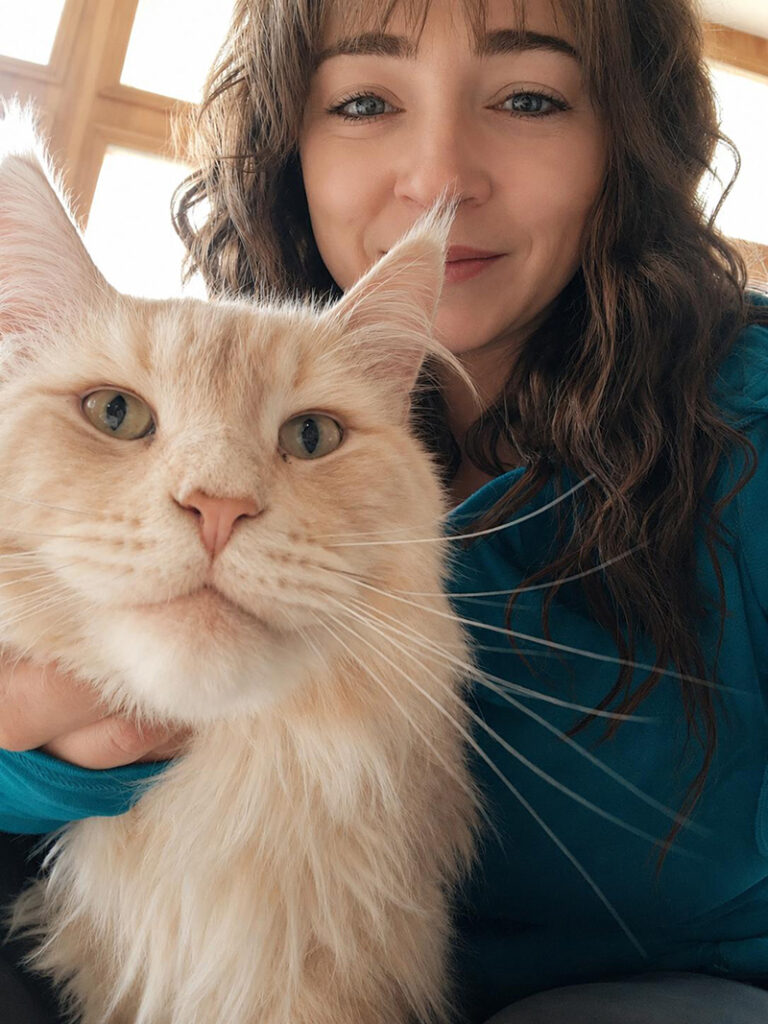
Meet Aidan Barba, Shelter Director at Auburn Valley Humane Society. Aidan completed Advanced Level Shelter Care Specialist (SCS) Certification and is currently pursuing Shelter Care Specialist Master’s Level Certification. In shelters and communities big and small, access to care depends on supported teams. If you’re ready to strengthen skills in medical care; animal behavior, training, and enrichment; population management; and operational decision-making, check out upcoming SCS sessions offered at no cost, #ThanksToMaddie!
Describe your role in three words.
Compassionate, decisive, and transformative.
What challenge or goal made you choose the Shelter Care Specialist Certification Program, and how has it impacted your perspective across roles?
I have been in animal welfare for eight years now, and throughout my career, two questions have consistently guided me: How can we do things more effectively and efficiently while keeping the best interests of the animals as our North Star? What can we learn from others so we aren’t reinventing the wheel every time we want to improve a policy, program, or standard of care?
Those questions ultimately led me to the Shelter Care Specialist Certification Program. I wanted to continue building my knowledge so I could show up better for both the animals and the people we serve. For me, that means not only learning best practices, but also understanding how to take what has worked successfully in other organizations and thoughtfully adapt it to the resources, capacity, and needs of the shelter I am working in.
As I have moved from a direct animal care role into shelter leadership, SCS has helped broaden my perspective. I now think not only about the care of the individual animal in front of me, but also about how our policies, systems, and programs influence the welfare of every animal moving through the organization and the community we support. It has reinforced for me that meaningful change doesn’t always require creating something entirely new. It often comes from learning what others in our field are doing well, applying evidence-based practices, and finding sustainable ways to make those practices work within your own organization.
How has your experience in the program changed a specific habit or practice in your day-to-day work?
One of the biggest changes the program has made in my day-to-day work is that I am much more intentional about questioning the “why” behind our practices. In sheltering, it can be easy to continue doing something because that is how it has always been done, particularly when you are working in a fast-paced environment where there is rarely enough time or resources.
The SCS program has encouraged me to slow down enough to ask whether a practice is actually accomplishing what we intend it to accomplish and, most importantly, whether it supports the welfare of the animals in our care and people. I find myself looking more frequently at current research, industry standards, and what other organizations are doing successfully before making changes.
As I have moved into leadership, that habit has become even more important. Instead of simply identifying a problem and creating a solution, I try to first understand the root cause, look at what evidence-based solutions already exist, and then determine how we can realistically adapt those practices to our shelter’s resources and capacity. It has changed my mindset from “How do we fix this?” to “What is the best practice, why does it work, and how do we make it sustainable here?”
What webinar do you wish everyone would watch, and what would you say to get a colleague to hit play?
The Future is Four – Overview of the 4 Rights of Animal Sheltering. It is presented by Dr. Kate Hurley and introduces the framework of providing the Right Care, in the Right Place, at the Right Time, to the Right Outcome. What makes it such a good “everyone in sheltering should watch this” choice is that it isn’t limited to medicine, behavior, adoptions, foster, or intake. It connects all of them together. The framework asks shelters to look at the entire system: what happens before an animal enters, whether shelter admission is actually the best option, what happens while the animal is in care, how resources and capacity affect welfare, how long animals stay, and how we remove barriers to appropriate outcomes.
That philosophy also lines up extremely well with the current ASV standards, which emphasize population management, behavioral health, appropriate housing, reduction of stress, and operating within an organization’s actual capacity for care.
I also recently started reading Humane Perspectives: Leadership in Animal Welfare, and I would recommend it to anyone in a leadership position in animal welfare. I really appreciate being able to learn from the experiences and perspectives of leaders from across our field. Leadership in animal welfare comes with some incredibly unique challenges, and I think there is tremendous value in continuing to learn from people who have navigated those challenges and helped move our profession forward.
What resources do you share most often with your team?
Right now, our organization is in a rebuilding chapter, and a big focus for me has been getting back to the foundations and giving our team tools that we can continue to build upon. One of the resources I keep coming back to is the ASPCA Animal Behavior Pathway Resources.
When you are rebuilding programs, I think one of the most important places to start is making sure everyone is speaking the same language. Behavior can be interpreted very differently from person to person, so teaching our team to objectively describe what they are seeing, rather than relying on labels or assumptions is critical. It gives us a stronger foundation for everything that comes next, from daily animal care and enrichment to pathway planning, adoption counseling, foster placement, and behavioral decision-making.
I really appreciate that these resources are practical and accessible for people with different levels of experience. Our goal isn’t to build everything overnight; it’s to create strong foundations, develop our team’s skills and confidence, and then continue building better programs from there.
What’s a moment from this work that reminds you why you do it?
It is really easy to get caught up in the day-to-day stress of working in a shelter environment. There is always another animal that needs something, another problem to solve, or another decision that needs to be made, and sometimes you can lose sight of the little moments that make this work so meaningful.
For me, one of those moments is playgroup. When I get the opportunity to step away from everything else and facilitate playgroup; or even just stand back and watch the dogs run, play, and genuinely enjoy themselves—it brings me a level of joy that is hard to describe. You get to see dogs simply being dogs, sometimes in the middle of what may otherwise be a stressful chapter of their lives.
Those moments remind me that not every impact we make has to be something big. Sometimes it is simply giving a dog the opportunity to run around with another dog, have fun, and experience a little bit of normalcy. Those are the moments that remind me why I continue to show up every day.
What is one thing about your shelter’s efforts to make shelter medicine happen that you are proud of?
We are a small shelter with a small veterinary team, but we have an incredible group of people, and I am immensely proud of what they are able to accomplish with the resources and capacity we have. Our veterinary team shows up every day and consistently goes above and beyond for the animals in our care. They are creative, they think outside the box, and they are always willing to ask, “What else can we try?” We are incredibly fortunate to have a veterinarian who brings that same mindset and is open to exploring different approaches when it means we may be able to provide a better outcome for an animal.
It is not lost on me that our veterinary department is truly one of the backbones of our organization. Shelter medicine requires adaptability, collaboration, and a willingness to work within limitations without allowing those limitations to define the level of care we strive to provide. Every person in our organization has a role to play, but our veterinary team’s role is crucial to our ability to care for the animals coming through our doors.
I have dreamed of working alongside a team this dedicated, and I am incredibly grateful for the caliber of people we have at Auburn Valley Humane Society. I am proud not only of the medicine they provide, but of the compassion, creativity, and commitment they bring to that work every single day.
Finish this sentence: Shelter medicine is…
Resourceful. It is looking at the animal in front of you, the resources you have available, and asking, “What can we do?” rather than focusing on what we cannot do. I have watched our veterinary team think outside the box time and time again to find creative solutions that allow us to treat an animal, improve their quality of life, and ultimately give them the opportunity for a positive outcome.