


In this retrospective study published in BMC Veterinary Research, Drs. Rachael Kreisler, Jeanette O’Quinn, and KSMP Outreach Veterinarian Chumkee Aziz set out to evaluate the safety and impact of neonatal vaccination. The positive results offer insight for shelters considering modified live FVRCP vaccination in kittens before four weeks of age. The study also adds new data to support updated neonatal vaccination recommendations from shelter medicine experts, which recognize that vaccination at younger ages may be appropriate when the benefits outweigh potential risks.
Lower mortality rates, zero adverse events
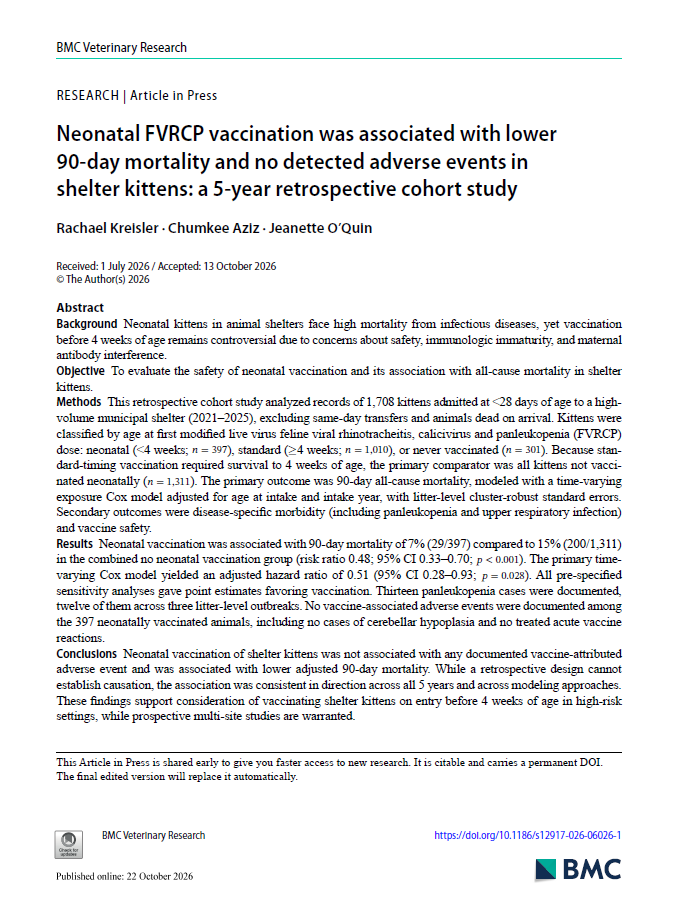
Overall, mortality was reduced by more than half among kittens who received modified live FVRCP vaccination before four weeks. Out of 1,708 kittens admitted to a high-volume municipal shelter at under four weeks of age, 397 were vaccinated before four weeks. In this group of kittens, 7% died within 90 days while still in shelter custody, including foster care. Among the 1,311 kittens not vaccinated before four weeks, the mortality rate rose to 15%. This comparison group included kittens vaccinated at four weeks or later as well as kittens who were never vaccinated.
The association with lower mortality remained when researchers analyzed the data in several different ways and accounted for factors such as kitten age and weight at intake, intake source and year, foster status, and shared risks among littermates. However, because this was a retrospective study at a single high-volume shelter, it cannot prove that vaccination itself caused the lower mortality or predict the same results in every setting. Differences in kittens’ underlying health that were not captured in the records may also have contributed.
Importantly, zero vaccine-attributed adverse events—including cases of cerebellar hypoplasia— were documented among the neonatally vaccinated kittens. Researchers specifically looked for cerebellar hypoplasia because it has been a theoretical concern with modified live FVRCP vaccination in very young kittens and pregnant cats, although available evidence does not establish that vaccination causes this condition.
The takeaway for shelters considering protocol change
Consider earlier FVRCP vaccination as one part of a broader approach when neonatal mortality or infectious-disease risk is meaningful. Continue moving kittens quickly to foster care or appropriate housing, minimizing length of stay, maintaining strong infection-prevention practices, and monitoring outcomes after implementation to understand impact.
Kreisler, R., Aziz, C. & O’Quin, J. Neonatal FVRCP vaccination was associated with lower 90-day mortality and no detected adverse events in shelter kittens: a 5-year retrospective cohort study. BMC Vet Res (2026). https://doi.org/10.1186/s12917-026-06026-1
Why did the researchers group kittens this way?
To make a fairer comparison, the researchers compared kittens vaccinated before 4 weeks with all kittens who were not vaccinated before 4 weeks, including both later-vaccinated and never-vaccinated kittens. Kittens vaccinated at four weeks or later had to survive long enough to reach that age before they could receive their first vaccine. Comparing kittens vaccinated before four weeks only with later-vaccinated kittens could therefore make the later-vaccinated group appear healthier simply because the most fragile kittens may not have survived long enough to be vaccinated later.
The study grouping better reflects the real-world choice at intake: vaccinate a neonatal kitten now or do not vaccinate during the neonatal period. It does not remove all possible differences between the groups, but it helps avoid giving the later-vaccinated group an automatic survival advantage.