


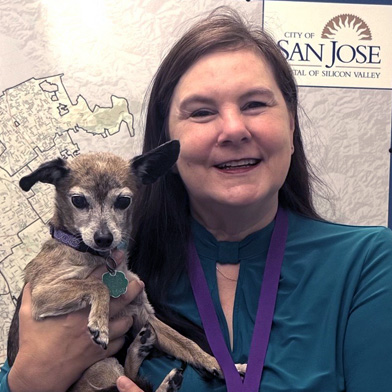
Meet Kiska Icard, Division Manager at San Jose Animal Care & Services. Kiska completed the Shelter Care Specialist (SCS) Welfare Track Certification. In shelters and communities big and small, access to care depends on supported teams. If you’re ready to strengthen skills in medical care; animal behavior, training, and enrichment; population management; and operational decision-making, check out upcoming SCS sessions offered at no cost, #ThanksToMaddie!
Describe your role in three words.
Manager, Mentor, Metrics-Specialist
What particular challenge or goal at your shelter made you choose the Shelter Care Specialist Certification Program?
City of San Jose has the largest animal intake in Northern California. In 2024, we were in a position where we WAY over capacity. At the end of June 2024, we had approximately 800 animals in our shelter. Today we are at approximately 500, and are working steadily to decrease the length of stay for all our shelter pets.
Because of the Shelter Care Specialist Program, our shelter now performs daily population rounds. The San Jose Animal Care staff believes that it is making a positive difference in the lives of our shelter pets. The population rounds enable us to track daily how the animals are doing in their kennels, and we’ve also received reports that some animals are doing better in the shelter because of these continuous efforts.
What is one thing about your shelter’s efforts to make shelter medicine happen that you are proud of?
We have recently started an official “Finder” program for dogs, and underage kittens. We’re doing basic vaccines on all these animals, so when they do come to the shelter, they have some basic immunity.
What webinar do you wish everyone would watch?
Daily population rounds videos from the Shelter Care Specialist Certification Program.
What resource do you share most often with your team?
Behavior Care Packages that address the kennel stresses we most often encounter at the shelter: barrier reactivity, dog-dog overarousal (without aggression), leash reactivity (mild/moderate), and rowdy adolescent behavior. These have helped our behavior team not only identify dogs with behaviors that could prolong their length of stay, but it also gives the team tools. These packages provide easy and low-cost support for dogs that are very easy to implement.
Who’s an animal that’s been important in your life, and how did they get their name or nickname?
Baloo—a Tibetan Mastiff and my first giant dog who was a custody case from San Francisco ACC. Baloo spent over five months in the shelter. His nickname was Boo-Boo Kitty, as he had a cat-like demeanor packaged in a 150-pound shaggy body.
What’s your go-to snack, beverage, or team ritual for a busy workday?
Cucumber salad—it’s something that almost everybody loves and it’s healthy and refreshing.
What inspires you?
Baking. I am a volunteer baker for an organization called “Cake4kids” and we bake and deliver birthday cakes for children who would not otherwise get a birthday treat. The case workers are so grateful when we deliver the cakes to them, and I am really inspired by all the volunteers’ creativity. I think it’s very healthy to have a hobby that’s outside of animal welfare.
What’s a moment from this work that reminds you why you do it?
I recently fostered a crunchy old blind chihuahua who wasn’t doing well at the shelter and wasn’t receiving any rescue commitment. Someone from Las Vegas saw her on our website and wanted to adopt her based on my photos and write-up. The adopter flew up from Vegas to San Jose. I met the woman at the airport, and completed her adoption there. She has the most wonderful life now and I often get updates of little Halmoeni (which means grandmother in Korean).
Finish this sentence: Shelter medicine is…
Science-based compassion. We have a robust Return-to-Field Program. I’m always amazed by our community’s level of concern for the cats in their neighborhoods, and equally impressed with how our shelter medicine prioritizes these cat’s well-being. Shelter medicine ensures the community cats who come to us are sterilized, given basic care when they are sick or injured, and provided with a compassionate ending when they are irremediably suffering. Shelter medicine is the quiet hero here.